Enterprise-grade market automation panorama
Vercadix: Precision AI-Driven Trading Automation
Vercadix reveals a crisp atlas of automation components powering contemporary trading workflows, covering data intake, model evaluation, and execution coordination. The content spotlights core capabilities, setup touchpoints, and monitoring readiness in a concise, executive-friendly format. Teams leverage this briefing to benchmark automation approaches and streamline governance and daily operations.
Capabilities designed for premium automation
Vercadix consolidates essential automation competencies—used by AI-powered trading helpers and bots—into a clean, comparable framework. Each card highlights a practical capability teams map into automated workflows. The copy emphasizes operational clarity, setup touchpoints, and monitoring-ready outputs.
AI-supported assessment
Concise outlines of AI-powered evaluation stages that ensure consistent decisioning across automated trading workflows.
Process orchestration
Clear segmentation of phases like data ingestion, rule tiers, routing logic, and execution coordination for autonomous trading systems.
Operational insights
Concise dashboards that reveal activity patterns and monitoring viewpoints for rapid decision-making.
Security posture
Overview of standard security practices surrounding automation tools, including access layers and data handling norms.
Audit-ready logs
Auditable activity records crafted for governance reviews and traceability across operations.
Configuration surfaces
Concrete overviews of configurable areas that align automation behavior with defined operational preferences.
Coverage across key markets
Vercadix demonstrates how automated trading bots and AI-assisted tools can be structured across diverse market segments. The focus remains on workflow modules, routing logic, and monitoring perspectives that stay consistent across asset classes. This section shows how teams articulate automation scope in a standardized, scalable manner.
- Asset taxonomy with consistent labeling
- Structured routing concepts for orderly operations
- Monitoring views for activity evaluation
Digital assets
Automation components for liquid markets, emphasizing pacing, visibility, and consistent operations.
FX and indices
Descriptive workflows for multi-session markets and cross-exchange routing.
Commodities
Automation scope definitions highlighting scheduling, configuration layers, and governance-friendly summaries.
How Vercadix structures automation workflows
Vercadix presents a step-by-step view of how automated trading bots and AI-powered trading assistance are typically described in operations documentation. The steps cover data handling, evaluation logic, execution routing, and review outputs. The layout supports quick desktop scanning while remaining readable on mobile devices.
Data ingestion and harmonization
Inputs are organized into consistent formats to support stable downstream evaluation within automated workflows.
AI-guided assessment
Model-driven logic is summarized to describe how automation interprets structured market context.
Route and execute
Orders are framed as routed actions with defined parameters, ensuring uniform handling and review.
Monitoring and governance review
Activity summaries and logs serve as governance-ready artifacts that enable visibility into operations.
Operational metrics as capability indicators
Vercadix uses compact indicators to summarize core capability areas from automation documentation. These labels facilitate quick comparisons across workflows, emphasizing tooling scope, observability, and configuration depth for AI-assisted trading.
Workflow descriptions mapped from intake to review artifacts.
Summaries crafted for operational visibility and governance reviews.
Configuration surfaces described as parameters and rule layers.
Log-style outputs framed for traceability and review workflows.
FAQ search and filtering
Vercadix includes a searchable FAQ to help visitors quickly locate topics related to automated trading bots and AI-powered assistance. The list is designed for scanning and supports live filtering through browser behavior. Each entry emphasizes functionality, workflow structure, and control concepts.
What does Vercadix cover?
Vercadix provides an operational snapshot of automated trading bots and AI-assisted trading, including workflow stages, configuration areas, and monitoring perspectives.
How is AI described within the workflow?
Vercadix presents AI-driven logic as a structured evaluation layer that supports consistent decisions across automation stages.
What kind of controls are discussed?
Vercadix highlights control surfaces such as parameter sets, rule layers, and review artifacts that align with operational preferences.
How are monitoring and summaries presented?
Monitoring is framed as activity summaries and logs that support traceability, governance, and operational visibility.
What does the security section emphasize?
Vercadix outlines security practices typically referenced around automation tooling, including access controls and privacy-conscious handling.
How can teams use the content?
Vercadix supports consistent documentation by organizing automation concepts into comparable capability areas and step-based workflows.
Risk management controls described as operational layers
Vercadix presents risk controls as layered governance features accompanying automated trading bots and AI-driven assistants. The cards summarize configuration areas teams reference when documenting automation behavior and review processes. Each item emphasizes structured controls, visibility into monitoring, and governance readiness.
Exposure parameters
Configuration summaries that describe how exposure limits can be expressed as clear operational parameters.
Order protections
Coverage of protective order conventions as part of a documented workflow for automation execution routing.
Session rules
Operational descriptions of time-based rules that support consistent behavior across different market sessions.
Review checkpoints
Structured checkpoints presented as review artifacts that support governance and operational clarity.
Activity summaries
Monitoring-ready summaries that help teams track automation behavior and document workflow outcomes.
Security posture and compliance references
Vercadix provides a concise collection of certification-style references aligned with professional expectations for automation tooling. The content centers on data handling principles, access discipline, and operational transparency, delivering a cohesive security narrative for automated trading bots and AI-powered trading assistance.
Disclaimer
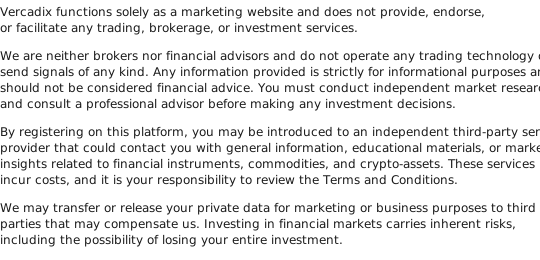
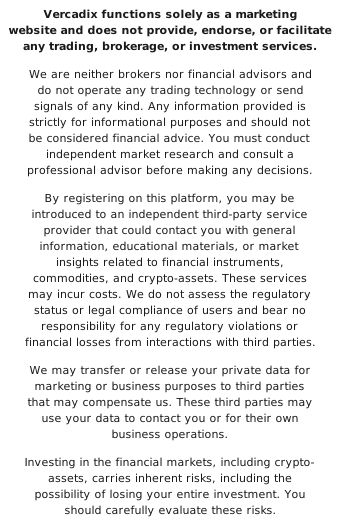
This website functions solely as a marketing platform and does not provide, endorse, or facilitate any trading, brokerage, or investment services.
Read More